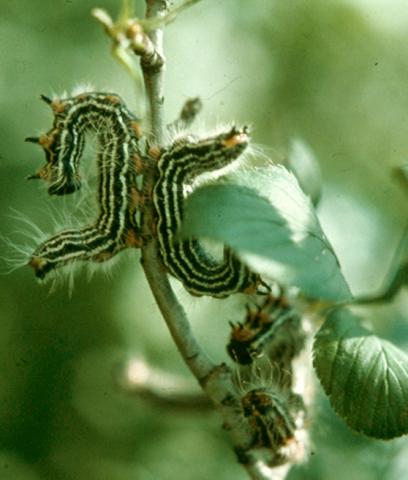
Yellownecked Caterpillar

Pathogen Type
Scientific Name
Datana ministra
Frequency
3
Severity
2
Hosts
These insects eat a wide range of trees and shrubs. Found mostly in the southern two thirds of Illinois, they occasionally show up in the northern third of Illinois.
Symptoms
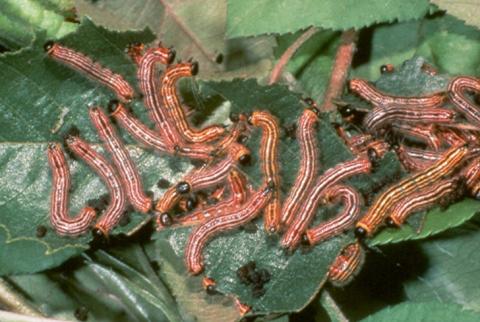
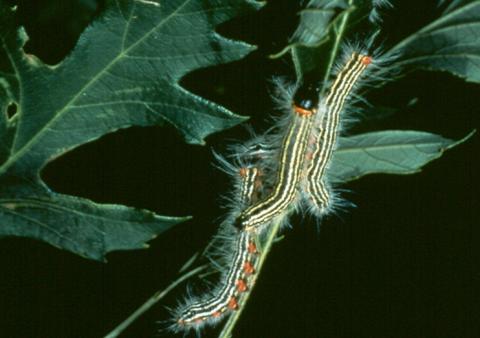
They travel and eat enmass (usually thirty to a hundred) for protection. They also raise the front and rear portions of their body in mass when a possible predator (birds & other insects) appear. The caterpillars eat holes in the leaves, leaving only the veins. As the caterpillars grow larger, they eat the entire leaf, leaving just the petiole. There is a yellow to orange band around the caterpillar body just behind the head that is easily seen on older caterpillars; that is how they got their name. Young caterpillars are reddish-brown with white stripes; older caterpillars are black with yellowish stripes. The head is black.
Cycle
These insects overwinter as pupae and the adult moths emerge in early summer. Eggs are laid on the lower side of leaves. Caterpillars are present for several weeks. Two to three generations occur per year.
Management
Because this insect feeds in groups, it is easily controlled by pruning off the branch that they are feeding on or by pulling off the caterpillars by hand. Bacterial and chemical insecticides are effective. This caterpillar is most numerous in late summer when its feeding causes little damage to the tree. In these cases, no control is necessary.
Credit

James E. Schuster, retired Extension Specialist, Horticulture & Plant Pathology and Dr. Philip L. Nixon, Extension Entomologist, Dept. of Crop Sciences, University of Illinois
PathogenID
100
Images
Image
Yellow-necked caterpillars.
picID
30982
Image
Yellow-necked caterpillars.
picID
30986
Image
Yellowneck caterpillars
picID
25887
Image
Yellowneck caterpillars lift front and rear ends to scare predators
picID
31201