Hosts
Agrobacterium tumefaciensattacks a broad spectrum of woody and herbaceous plants in more 140genera. Euonymous, brambles, grape, maple, rose,and willow are commonly infected plants in Illinois.
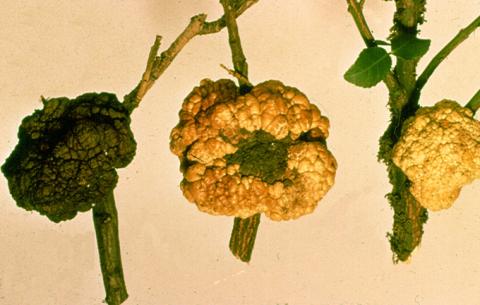
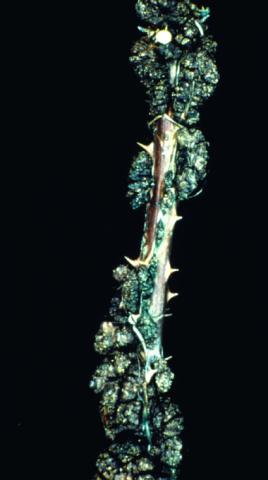
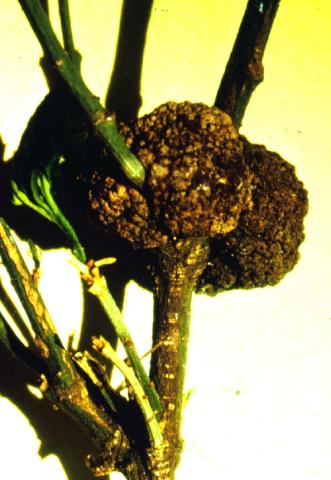
Agrobacterium tumefaciens causes the host plant to produce galls at the crown, on roots, or on branches. The gall is a light tan color at first but turns brown to black with age. Galls are soft and round when they first form but later develop an irregular, rough, and corky surface with a woody interior. The size of the gall varies from the diameter of a pea to a foot or larger. Infected plants may be stunted, discolored, and die back. Young plants eventually wilt and die while older plants survive in a weakened condition.
Often the galls are found near the soil line, at a graft union, or bud union. On willow, populars, and other trees, the galls may be found on branches as much as20 to 40 or more feet above the ground. This disease may be a localized infection or it may be systemic on some plants such as the brambles and grapes.
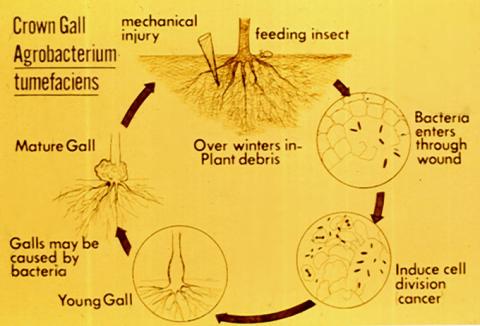
Since the bacterium is usually a weak pathogen, entry is through a natural opening (for example - a lenticel) or a fresh wound that is less than 24 hours old on the crown, the roots, or the branches. Once introduced, the crown-gall bacterium survives in diseased tissue and in soil, where it lives as a saprophyte in organic debris for several years. The bacterium is spread in soil water, by rain splash, or by machinery, and thus the bacterium is able to infect new plants.
James E Schuster, retired Extension Specialist and Dr. Mohammad Babadoost, Plant Pathology, Dept. of Crop Sciences University of Illinois Extension