Twomarked Treehopper

Pathogen Type
Scientific Name
Enchenopa binotata
Frequency
2
Severity
3
Hosts
Twomarked treehoppers cause damage to hoptree or wafer ash (Ptelea trifoliata); black walnut, butternut, black locust, viburnum, redbud and bittersweet.
Symptoms
The feeding resuts in honeydew which allows the fungus sooty mold (mycelium is black) to grow and turn the plant blackish. Egg laying resuts in slits in bark.
Cycle
The twomarked treehopper will overwinter as an egg under bark. Newly hatched nymphs move to the tips of the new shoots where they extract plant sap in mass. The nymphs are brown to dark gray. After a little more than a month, the twomarked treehopper becomes an adult. As adults, they often line up in a row on the new shoot. Females lay eggs untill August. However once egg laying starts, it will continue till the adult is frost killed. The female treehopper has a saw like ovipositor. She use this to make a small cut in the twig. The eggs are forced through the narrow cut so that they are left under the bark. Once the egg laying for the individual cut is completed, the adult female seals the cut.
Management
This insect rarely causes enough damage to warrant control, even though the insect itself is abundant.
Credit

James E. Schuster, retired Extension Specialist, Horticulture & Plant Pathology and Dr. Philip L. Nixon, Extension Entomologist, Dept. of Crop Sciences, University of Illinois
PathogenID
90
Images
Image
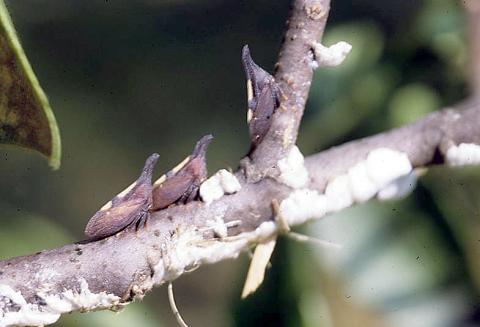
Twomarked treehopper adults and egg froth on wafer ash. P. Nixon.
picID
38125
Image
Twomarked treehopper egg froth on wafer ash. P. Nixon.
picID
38126