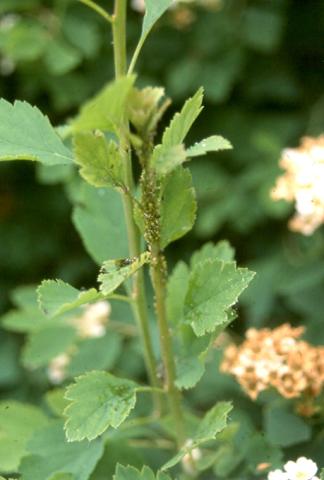
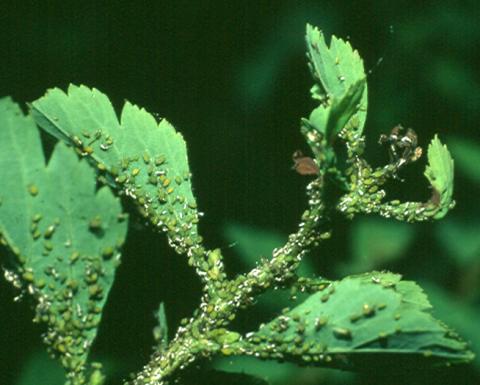
Spirea aphid is found in every state on spireas and crabapples. The aphid occurs in large numbers and its feeding often causes the leaves to distort, curl and pucker. The aphid has a dark head and thorax while the abdomen is pale green. Particularly on spirea, large amounts of honeydew, and corresponding sooty mold growing on it, is produced.
Cycle
During warm weather, the aphid gives birth to live young that are all females. The new aphids can soon produce their own live young. In northern states, as cooling weather and shortening days occur, the aphids are born in a sexual state and lay eggs that overwinter on any spirea that is available. Overcrowding causes the aphid to give birth to winged aphids so that they can fly to other branches and plants.
Management
Heavy rains can wash the aphids off the plants resulting in their deaths. Occasionally in Illinois (usually during hot, humidweather) a fungus will attack and kill the aphids. In addition many predators feed on aphids.
Credit
James E. Schuster, retired Extension Specialist, Horticulture & Plant Pathology and Dr. Philip L. Nixon, Extension Entomologist, Dept. of Crop Sciences, University of Illinois