SNEED (Sudden Needle Drop or Spruce Needle Drop)

Pathogen Type
Frequency
2
Severity
3
Symptoms

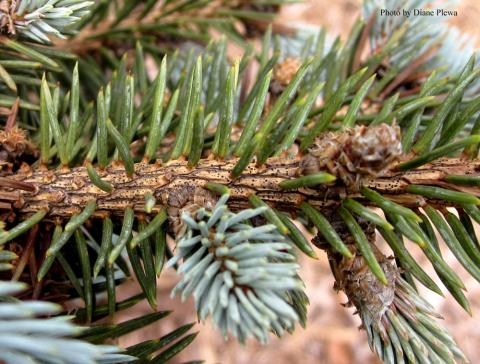
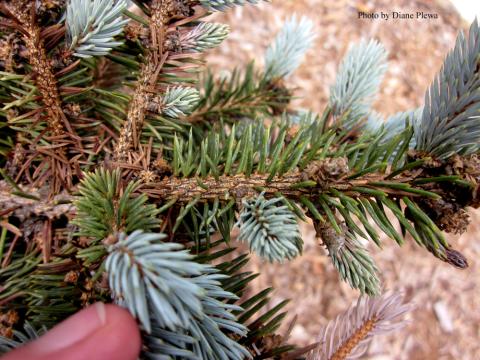
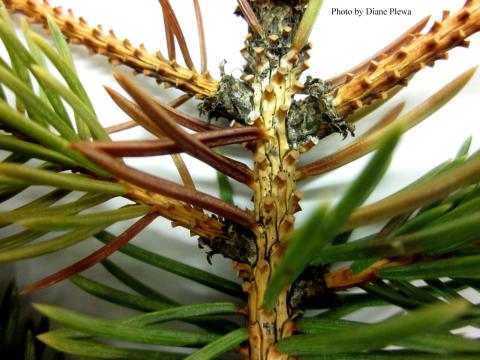
Symptoms of SNEED are yellowing and eventual browning of older needles. Affected branches may be scattered through the canopy. Frequently, by autumn, all of the needles on the affected branches fall off except the newest needles on the tips of the branches. Eventually the canopy of the tree thins, sometimes leaving bare branches.
Cycle

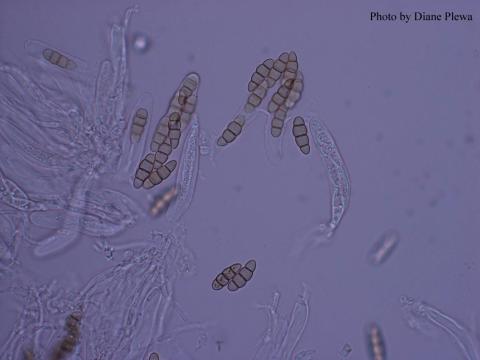
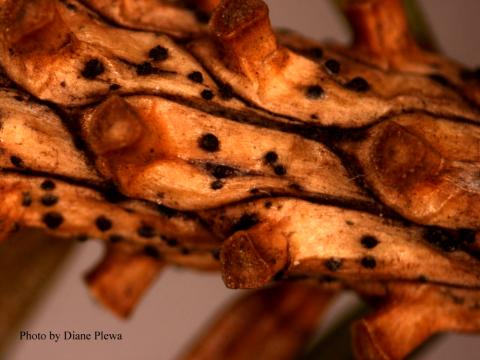
(SNEED) Sudden Needle Drop (also sometimes called Spruce Needle Drop) has been found on Norway, white (Black Hills) and Colorado blue spruce trees. The fungus Setomelanomma holmii has been found associated with symptoms of sudden needle drop, but it has not been proven that this fungus is the cause of the SNEED. Currently, Setomelanomma holmii is not considered a true pathogen. The fungus forms small, black, round spore-producing structures on the stems and bud scales of affected spruce. It can be identified as Setomelanomma by looking at the spores under a compound microscope. Other fungi growing on spruce trees also produce small black structures on healthy spruce branches, so microscopic examination of the spores is necessary to tell if Setomelanomma is present. The disease is not found on or in the needles, but instead is found on the woody tissue at the base of the needles. It is not a problem on a healthy tree growing in a good environment. However, when the tree becomes stressed or weakened due to drought, root constriction, having been planted in poor soil or due to other environmental problems or due to an infectious disease pathogen, this fungus may become involved with the decline of the tree. This disease was identified in the Midwest and Canada in 1998. (It was known to occur in France before then.) Since it is a relatively new disease, little is known about its life cycle.

Management
A fungicide used to manage Rhizosphaera needle cast seems to help manage this fungus.
Credit

Jim Schuster - Retired Extension Specialist, Horticulture & Plant Pathology, University of Illinois

PathogenID
229
Images
Image
immature spores at 400X, photo by Diane Plewa
picID
167830
Image
pseudothecia close up, photo by Diane Plewa
picID
167831
Image
fruiting bodies/spore dtuctures, photo by Diane Plewa
picID
167832
Image
fruiting bodies/spore stuctures, photo by Diane Plewa
picID
167833
Image
sneed fruiting bodies on twig, photo by Diane Plewa
picID
167834
Image
branch showing missing needles, photo by Diane 


branch showing missing needles, photo by Diane Plewa
picID
167835