Hosts
Pines
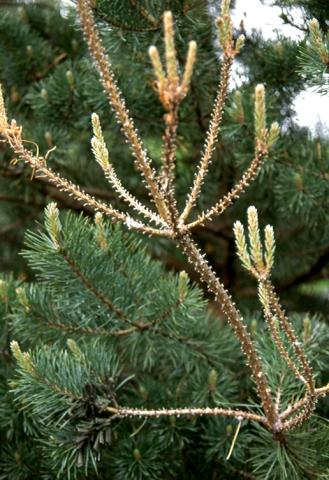
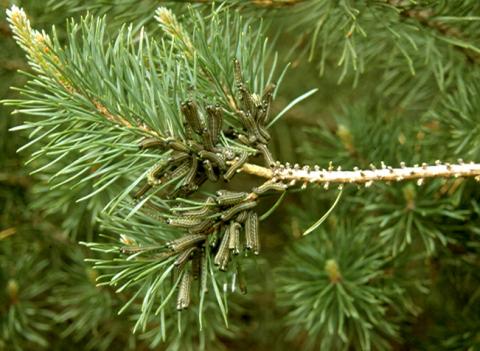
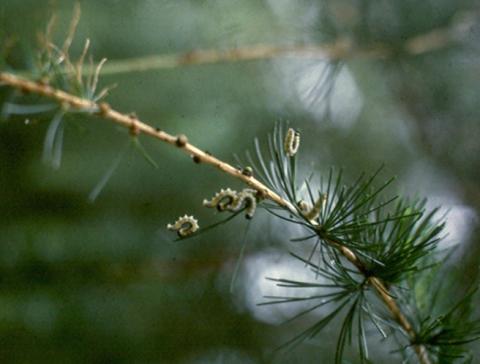
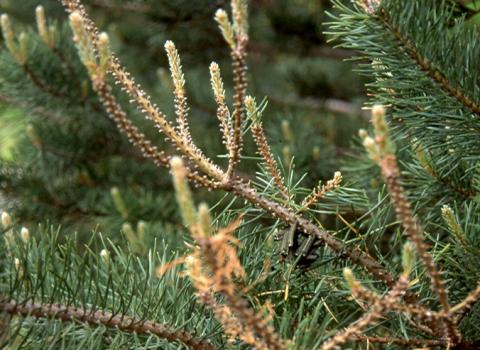
At first, the small sawfly larvae eat only the outer layer of the needles. As they grow larger, the entire needle is eaten.
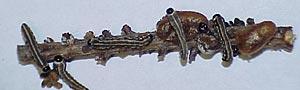
The European pine sawfly (Neodiprion sertifer) is found in large numbers and "waves" in mass as a means of scaring off predators. It feeds on mugo pines as well as many other pines. This sawfly larva feeds for about six weeks. They feed on older mature leaves, leaving the emerging needle alone.
Sawflies are non-stinging wasps that have their ovipositor serrated like a saw. The "saw" is used in making slits in the plant. Eggs are then deposited in the slit.
European pine sawfly mature larva has a black head and is grayish green with black lines along it side. There is one generation per year. t pupates in the leaf litter under the pine and adults lay eggs in slits in older needles as new growth is emerging.
The redheaded pine sawfly (Neodiprion lecontei) over-winters in a prepupal stage in the litter under the tree. In the spring after completing pupation, the adults emerge. Eggs are laid in slits in the edge of needles. The larvae feed on the foliage. After four weeks the sawflies fall to the ground to spin a cocoon. There is usually a second generation later in the growing season. It is not usually found in the home landscape. However it is a serious pest in forest and nurseries in the northern United States and in Canada.
The white pine sawfly also feeds in the spring. It primarily attacks Eastern white pine, but will also attack other pines. Its life cycle is similar to the redheaded pine sawfly except that there is no second generation later in the growing season.
Diseases and mice eating the pupae often cause the populations of redheaded pine sawfly to crash.
Failure to control the European Pine Sawfly insect is not usually fatal to the plant. However, a more sparse plant will be the result. However, redheaded and white pine sawflies can kill branches or the entire tree if numerous.
If an insecticide is applied, it is best done when larvae are hatching or very small to minimize damage. Time to treat often corresponds to saucer magnolia petal drop. Control as soon after egg hatch as possible. Check with your local land grant university (Cooperative) Extension Service for recommended insecticide.
James Schuster, retired Extension Specialist, Horticulture & Plant Pathology, and Dr.Philip L. Nixon, Extension Specialist-Entomology, Department Crop Sciences, University of Illinois at Urbana-Champaign.