Marssonia Leaf Spots and Blights

Pathogen Type
Scientific Name
Marssonia spp.
Frequency
3
Severity
2
Hosts
This disease affects Populus spp (poplar and aspen) and is more of a forestry disease than a landscape problem. However, with poplars growing in landscapes during prolonged wet weather, it can be a problem. Marssonia betulae causes anthracnose on birch trees and Marssonia thomasiana causes anthracnose on bittersweet.
Symptoms
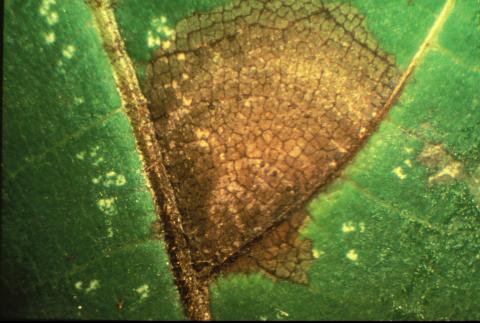
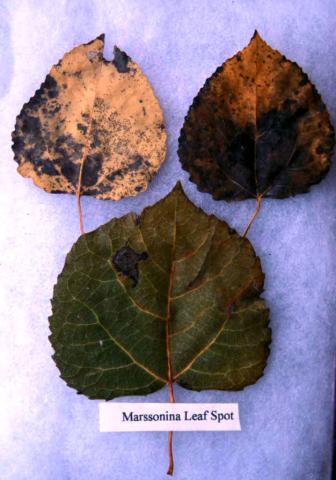
The spots/blotches on the foliage are brown. Badly infected leaves can turn all brown by midsummer (July) and be defoliated by August. Severe defoliation may cause the tree to leaf out again. The tree uses up part of its food reserves and becomes more prone to other diseases. In addition, late emerging new growth may not hardened off sufficiently and therefore may be prone to winter die-back. Badly defoliated trees tend to produce less new wood during the next one to two years.
Cycle
The fungus overwinters in the dead leaves or infected twigs. Spores are released in spring and cause infection as leaves emerge. Leaves on lower branches tend to be infected first and infection spreads upwards through the growing season.
Management
There is no practical control for this disease in a forest setting. In the home landscape, follow good sanitation practices.
Credit

James E. Schuster, retired Extension Specialist, Horticulture & Plant Pathology, University of Illinois

PathogenID
44
Images
Image
Marssonia leaf spot on poplar.
picID
25479
Image
Marssonia leaf spot on black walnut.
picID
54769