Leaf Miner on Arborvitae and Junipers

Pathogen Type
Scientific Name
Argyresthia cupressella
Hosts
Arborvitae and Junipers
Symptoms

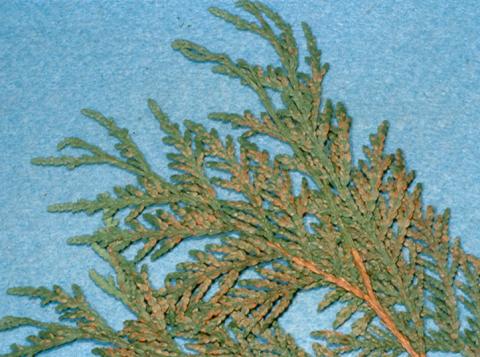
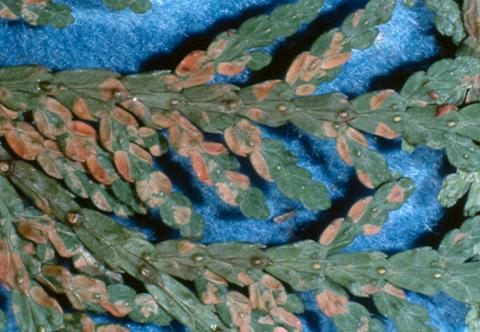
During the growing season, little damage is noticed. Not until winter when a yellowing of the leaf scales followed by browning is any noticeable damage visible. The dead twigs frequently break off easily due to their dried out condition.

Cycle
Leaf miners (Argyresthia cupressella) attack both arborvitae and junipers. The miner tunnels into the growing tip and kills it. Heavy infestation can make the entire plant look brown and dead. The adult is a moth. It is a silvery tan and is out only in the spring and early summer. Eggs are laid on the branch tips that are one or two years of age. Upon hatching the larvae tunnel into the leaf scales and mines/tunnels until winter or even the following spring. Once the larvae are finished feeding, they leave the mine and spin a cocoon (pupae stage) in the dead or still living foliage. Weeks later, adults emerge, mate and lay eggs to start another cycle of feeding.
Management
Rarely are leafminer numbers high enough to warrant control on arborvitae or junipers. If numbers are high, insecticides applied in mid-spring and repeated two weeks later should be effective.
Credit

James Schuster, retired Extension Specialist, Horticulture & Plant Pathology, and Dr. Philip L. Nixon, Extension Specialist-Entomology, Department of Crop Sciences University of Illinois at Urbana-Champaign.
PathogenID
251
Images
Image
Arborvitae leaf miner damage
picID
30930
Image
Aborvitae leaf miner damage - close up
picID
30931