Juniper Webworm

Pathogen Type
Scientific Name
Daeborneris marginella
Frequency
1
Severity
2
Hosts
Juniper webworm attacks horizontalis, depressa, aurea and most of the Chinese junipers.
Symptoms
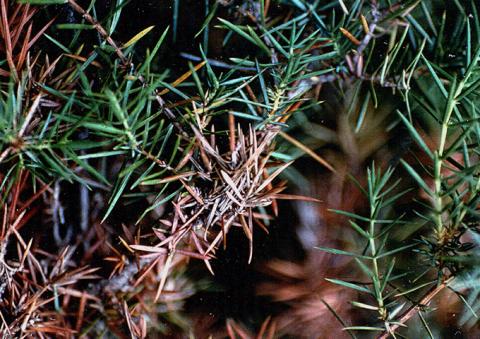
The larval feeding causes the foliage to turn brown.
Cycle
The adult moths are active in June and July and have one generation per year. Adults last about two weeks and are often found on or near the host plants. The adult moth has a copper brown band with a white stripe on each side on the forewings. Eggs are laid singly on the leaves or at the axils of the current year's growth. The female lays between fifty and one hundred and twenty or more eggs. The eggs change from white to yellow then yellow to orange with the final color being red. The new larvae feed as leaf miners. Many leaves are mined before the larvae emerge and feed as surface feeders. While they are surface feeders, they protect themselves with silken tubes that they spin over the feeding site. Initial feeding usually goes unnoticed. These webworm over winter as larvae. Feeding is often resumed in the spring and additional webbing is produced.
Management
There are several natural predators on juniper webworm. They include a mite and several insects. Chemical controls are also available.
Credit

James E. Schuster, retired Extension Specialist, Horticulture & Plant Pathology and Dr. Philip L. Nixon, Extension Entomologist, Dept. of Crop Sciences, University of Illinois
PathogenID
81
Images
Image
picID
33831