Cytospora Canker of Spruce

Pathogen Type
Scientific Name
Leucostoma kunzei (Cytospora kunzei)
Frequency
4
Severity
5
Hosts
The fungus Leucostoma kunzei (Cytospora kunzei var. picea) causes Cytospora canker, a stem disease. It appears most frequently on Colorado spruces and Norway spruces. Occasionally, it attacks Koster's blue spruce, Douglas fir, and red and Eastern white pines.
Symptoms
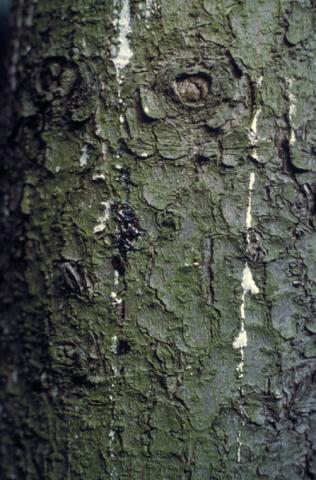
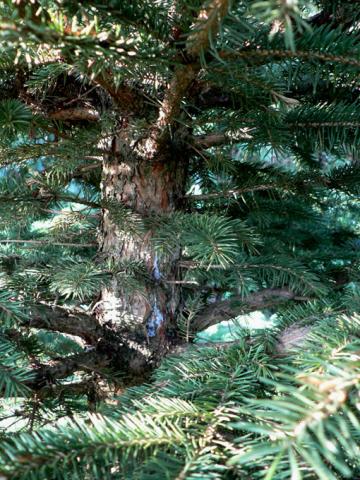
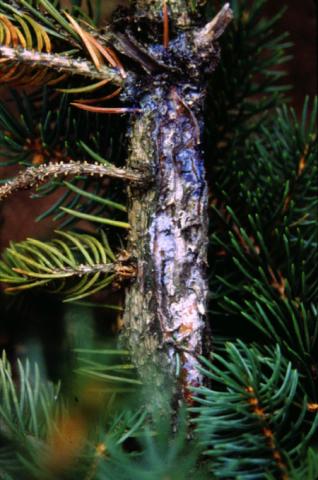
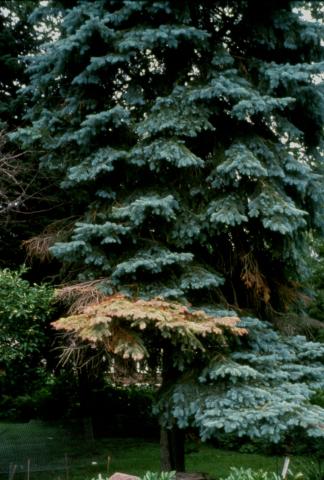
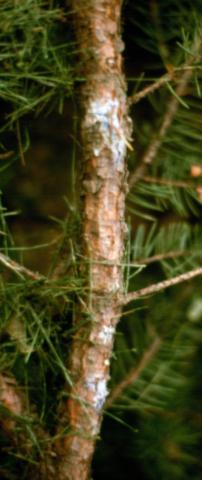
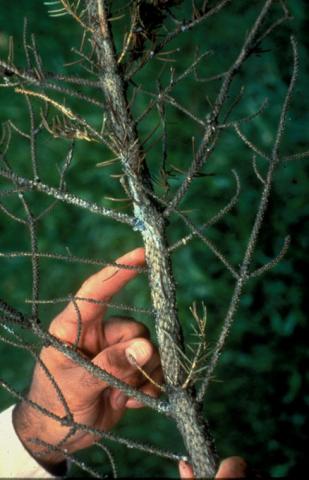
Browning of needles and dying of the lower branches of affected trees are usually the first symptoms of Cytospora canker. As the disease progresses, it spreads to higher branches. Occasionally branches high in the tree are attacked even though lower ones are healthy. In time, affected trees become unsightly and lose their value for ornamental purposes. Needles may drop immediately from infected branches or the needles may persist. Eventually dry, brittle twigs remain in sharp contrast with unaffected branches.The cankers produced are inconspicuous because the affected bark does not noticeably change color or become depressed. Frequently, amber, purplish white or white patches of resin appear on the bark in areas where cankers have formed. What color the resin may be depends on how much air mixes with the resin. The development of trunk cankers may result in girdling and death of affected trees.
Cycle
Just under the outer layer of bark in the area that separates the diseased and healthy tissue, tiny, black, pinhead-like fruiting bodies of the fungus develop. These fruiting bodies contain minute spores which can be spread by rain, wind, or pruning tools. Cytospora canker is most common on trees over fifteen years old, but may occur on younger trees as well.
Management
Control of Cytospora canker requires that all diseased branches be cut back to the nearest living laterals or to the trunk of affected trees. The bark should not be injured unnecessarily, since the fungus may enter through wounds resulting from injuries. When the branches or trunks of affected trees are wet; spores exude from cankers onto the surface of the bark. Pruning at this time should be avoided, since pruning tools may spread spores. Since weakened trees are susceptible to this disease, fertilizing to stimulate vigorous growth may help to combat Cytospora canker. Fertilizing may also stimulate new growth that may fill in small vacant areas in the trees but large dead areas seldom fill back in. Both too much and too little water are stresses that can weaken spruces. Make sure there is adequate drainage and water the trees during droughts. There are no fungicides that effectively control this disease and frequently trees die despite the proper pruning fertilizing and watering.
Credit

Written by James Schuster, retired Extension Specialist, Horticulture & Plant Pathology,University of Illinois at Urbana-Champaign.

PathogenID
17
Images
Image
"Bleeding" cytospora canker on spruce.
picID
33901
Image
"Bleeding" cytospora canker on spruce.
picID
33902
Image
"Bleeding" cytospora canker on spruce.
picID
33903
Image
"Bleeding" cytospora canker on spruce.
picID
33908
Image
"Bottom up": The most common way spruces die due to cytospora canker.
picID
25507
Image
"Bleeding" cytospora canker on spruce.
picID
25733
Image
Advanced cytospora canker killing a Colorado spruce.
picID
25927